_______
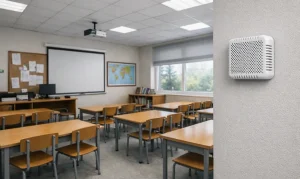
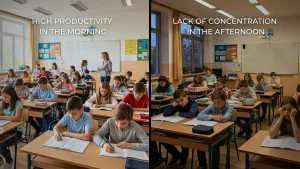
Primary and secondary schools in Slovenia recently initiated a pilot project driven by a critical operational observation: teachers and administrators noticed a sharp, consistent drop in student focus, engagement and cognitive productivity during the second half of the school day. Administrators hypothesized that this phenomenon was not a pedagogical failure or routine fatigue, but rather a direct physiological response to hyper-accumulated carbon dioxide and total volatile organic compounds (TVOCs) within crowded, poorly ventilated classrooms. To test this hypothesis objectively, the school district deployed Senspuck Pure SPU20 indoor air quality sensors. This case study details the technical architecture, deployment methodology and operational findings that ultimately confirmed the hypothesis and established a blueprint for scalable, data-driven indoor environmental management.
The Core Problem: The Cognitive Cost of Invisible Air Pollution
In typical classrooms, occupant density is exceptionally high relative to total cubic volume. Without active, mechanical ventilation systems or automated intervention triggers, air degradation happens rapidly.
Carbon Dioxide Accumulation
An average human exhales roughly 15 to 30 liters of CO2 per hour depending on physical activity and age. In a sealed classroom of 25 to 30 students, baseline ambient CO2 levels (typically 400 ppm) can easily exceed 1,500 to 2,500 ppm within 45 to 60 minutes of occupancy.
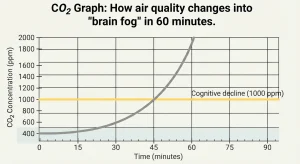
Rapid accumulation of indoor CO2 in an unventilated space, showing levels crossing the 1,000 ppm cognitive decline threshold at 45 minutes and surging toward 2,000 ppm by minute 60.
The Cognitive Penalty
Scientific literature extensively documents that CO2 concentrations exceeding 1,000 ppm lead to measurable decrements in human cognitive function, complex decision-making, information processing and strategic thinking. At 2,000 ppm, drowsiness, headaches and lethargy become widespread.
TVOCs and Aerosol Load
Beyond CO2, off-gassing from building materials, cleaning agents and high occupant density elevate TVOC levels, while stagnant air severely increases the risk of airborne viral transmission.
The Operational Blind Spot
Prior to the pilot, school staff relied entirely on subjective feelings to decide when to open windows. This re-active approach resulted in excessive heat loss during winter months, volatile temperature fluctuations and delayed interventions that occurred only after cognitive performance had already degraded.
Solution & System Architecture
To capture high-resolution, uncompromised environmental telemetry without burdening school infrastructure, the project required an industrial-grade, non-disruptive IoT architecture.
Hardware Deployment
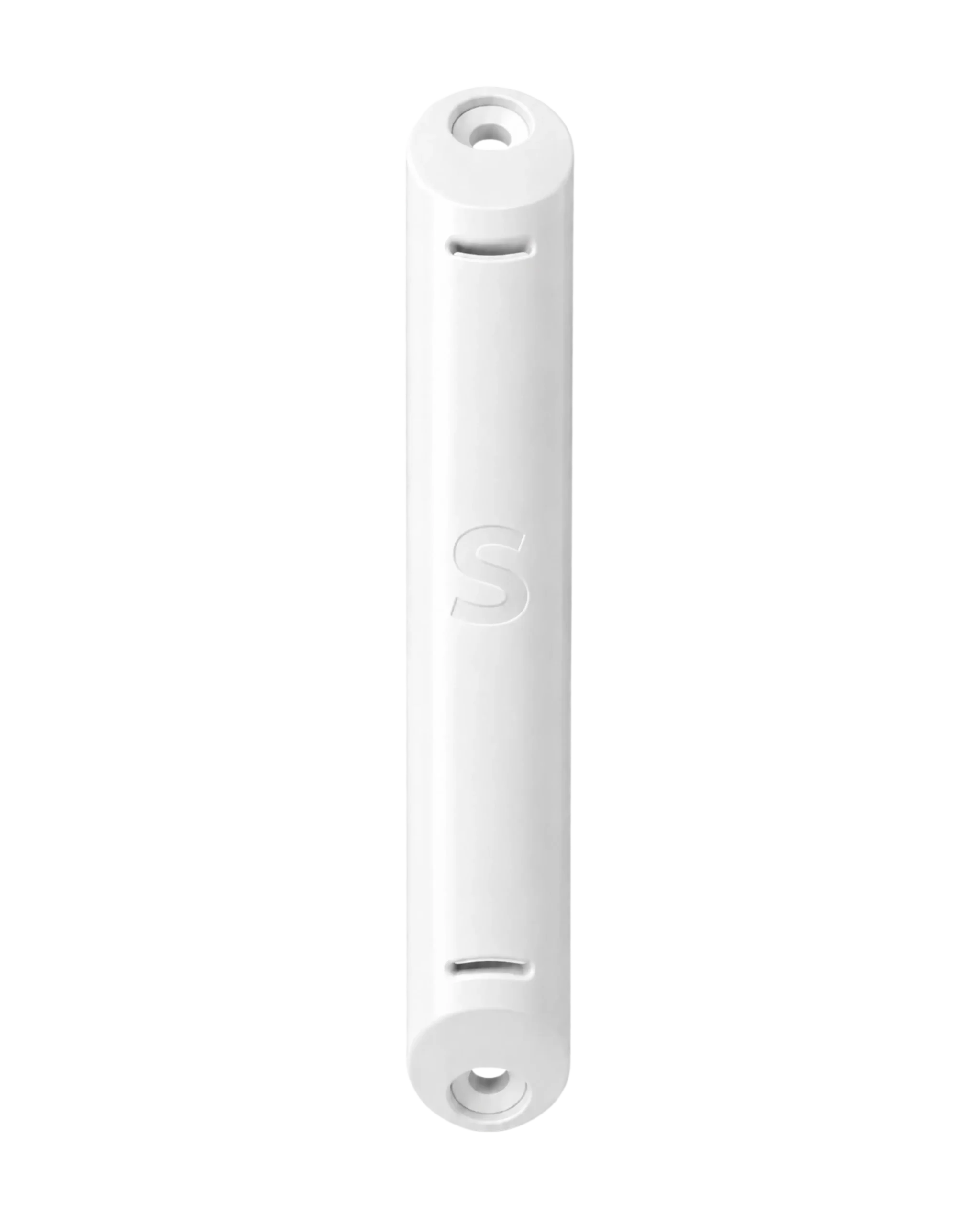
The Senspuck Pure SPU20 was chosen as the core sensing node for several distinct technical advantages.
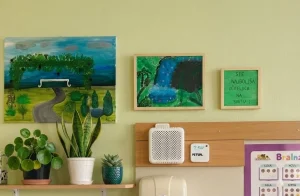
Dual-Parameter Precision: The SPU20 integrates high-accuracy Non-Dispersive Infrared sensors for CO2 monitoring alongside advanced metal-oxide semiconductor elements for TVOC tracking.
Industrial Reliability & European Manufacturing: Sourced and assembled within the European Union, the SPU20 provides robust long-term calibration stability, minimizing drift over multi-year deployments.
Flexible Configuration: The devices support NFC and Over-The-Air reconfigurability, allowing technicians to alter measurement reporting intervals depending on classroom occupancy schedules.
Power Efficiency: Operating on internal batteries designed to last for years, eliminating the need for AC power drops or unsightly wiring across historic masonry walls.
LoRaWAN Protocol
Given the structural thick walls and multi-level layout of older school buildings, cellular or standard Wi-Fi deployments presented significant signal attenuation and security configuration hurdles.
The system utilized LoRaWAN operating on sub-GHz license-free frequency bands. Signals easily penetrate reinforced concrete, brick and multiple interior partitions, allowing a single gateway placed centrally in the school building to ingest data streams from every classroom simultaneously.
LoRaWAN’s high link budget ensures robust packet delivery even in dense architectural environments, capable of bridging distances up to 15 km outdoors, easily covering school campuses and administrative annexes. Raw wireless frames transmitted by the SPU20 sensors were picked up by leveraging the municipality’s pre-existing LoRaWAN network, eliminating the need to deploy dedicated infrastructure from scratch and routed directly to an open-source ChirpStack network server instance.
ChirpStack handles secure device authentication, encryption key management and packet deduplication. Every telemetry packet included timestamp, device ID, temperature, relative humidity, barometric pressure, CO2 concentration and TVOC index.
Deployment Methodology & Best Practices
Accurate environmental sensor performance relies on precise placement that accounts for spatial physics.
Mount sensors on interior walls at breathing height (approximately 1.6m), avoiding dead zones in corners and thermal stratification loops near the ceiling.
Additionally, shield them away from direct sunlight, drafts from exterior doors and direct airflow from HVAC supply or return vents to prevent false readings.
Before automated operations begin, the system must collect raw data for 14 days to establish a baseline curve connecting typical occupancy with natural air exchange under the specific conditions of the space.
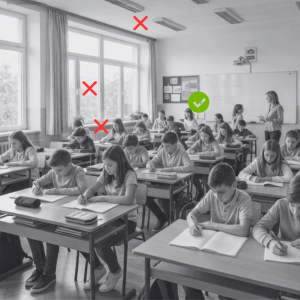
This grayscale image serves as a visual guide illustrating incorrect and optimal locations for installing an indoor air quality sensor.
Operational Findings & Hypothesis Validation
The empirical data gathered by the SPU20 sensors over the multi-week test period definitively confirmed the administrative hypothesis, revealing severe structural patterns in indoor air degradation.
The 45-Minute Exponent: Data proved that in a closed classroom, CO2 levels crossed the critical 1,000 ppm threshold within 45 minutes of a lesson commencing. By the end of a 90-minute block, concentrations frequently breached 1,800 to 2,200 ppm.
Correlation with Attention Slumps: When cross-referenced with teacher behavioral logs and assignment error rates, the performance dip among students directly mirrored the upward trajectory of the CO2 curves. The afternoon “slump” was revealed to be primarily chemical asphyxiation and oxygen starvation rather than natural circadian fatigue.
The Ineffectiveness of Manual Guesswork: Historical practices of opening windows “when it felt stuffy” proved highly unreliable. Teachers delayed opening windows until levels reached extreme toxicity or conversely, left windows open too long during winter, causing indoor temperatures to drop below comfort thresholds, which triggered thermal discomfort complaints.
Strategic Value and Scalability
Transition from Reactive to Proactive Building Management: Rather than responding to subjective complaints after the fact, the school administration implemented threshold-based visual alerts prompting 5-minute cross-ventilation breaks before CO2 concentrations impacted cognitive function.
Energy Optimization Without Sacrificing Health: By utilizing precise telemetry, ventilation became targeted and brief rather than continuous or random. This prevented massive thermal energy losses, optimizing district-wide heating bills.
Data-Backed Health Compliance: The open architecture model ensured that the school district owned its data entirely, allowing local researchers to publish transparent findings on indoor air quality, which subsequently secured regional funding for broader district-wide IoT retrofits.
Replicability for Corporate Environments: The success in this educational pilot serves as a direct proof-of-concept for commercial office spaces. If invisible CO2 accumulation measurably degrades student learning capacity, it identically suppresses executive decision-making, code generation and white-collar productivity in modern enterprise buildings.
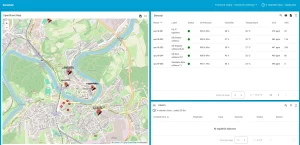
Senstick rental dashboard showing live monitoring across multiple school locations in Novo mesto. Based on insights gathered from our rented sensors, clients successfully identified environmental issues and implemented key changes to ensure healthy indoor air quality.
The Path Forward
As educational institutions and municipalities face mounting pressure to balance energy conservation with stringent health standards, static building management systems are no longer sufficient.
The integration of high-precision sensors like the Senspuck Pure SPU20 with scalable LoRaWAN infrastructure proves that deep environmental visibility is achievable without intrusive civil works or recurring vendor lock-in.

By turning invisible air quality metrics into actionable, real-time data, facilities can finally engineer spaces that actively support human health, cognitive vitality and long-term sustainability.