

In the world of the IoT, the market is flooded with marketing buzzwords about the cloud, artificial intelligence and solutions for everything. But when you install a device in an industrial basement or under a steel structure, all those fancy words are meaningless. That’s when only physics matters. RF characteristics, power supply stability and precise engineering.
At Senzemo we claim to have the best IoT antennas and hardware. We back up this claim with facts and expertise led by our engineer, Jure Jazbec.

Let’s take a look at what real engineering work looks like in the development of reliable IoT hardware.
Starting from Scratch
Developing a professional PCB does not start with choosing modern components but with analyzing the fundamental constraints.
As Jure Jazbec points out, the first step is to define mechanical mountings, placement of connectors, antennas and sensors, along with defining power requirements. Only then do microcontrollers, radio modules and regulators enter the picture.
Component placement
Every major component has a deliberate purpose, whether dictated by signal path length, current loop size, thermal hotspots or electromagnetic compatibility.
Capacitors
A capacitor sits next to a power pin not because of leftover space, but because circuit stability demands it.
The golden rule of layout
Proper component placement is already half the work when it comes to successful routing.
Under pressure from deadlines and budgets, many take shortcuts. At Senzemo, however, a strict standard applies: time pressure is never an excuse for flawed power distribution, poor current paths or ignored datasheets. If a design choice is questionable from day one, it simply never makes it onto the PCB.
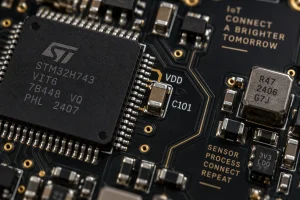
Capacitors placed directly next to power pins ensure maximum circuit stability.
Uncompromising Robustness and Power Supply Design
Focusing solely on a microcontroller’s sleep current is a classic trap that leads to dead batteries in the real world. The MCU is often just the tip of the iceberg. True energy management is a systems engineering problem where hidden drains silently sabotage battery life.
To build a bulletproof product, your energy budget must account for these critical, real-world factors:
Regulator Quiescent Current
Voltage regulators and LDOs consume baseline power just to stay alive, even when your system is asleep. Choosing the wrong regulator will instantly neutralize an ultra-low-power MCU.
Overlooked Passives and Peripherals
Forgotten pull-up, pull-down resistors and sensors that aren’t fully powered down can bleed current or create parasitic power loops through I/O pins.
Leakage Current
Semiconductor physical limits and improperly configured GPIO pins, such as floating inputs that cause internal shoot-through current inside buffer gates.
Radio Transmissions
The heaviest energy hitters in your system. Efficiency here depends not just on transmit power, but on connection times, protocol overhead and retransmissions.
Active Time Bloat
Every extra millisecond the system spends awake due to unoptimized firmware drastically scales up your average current draw.
When designing a battery-powered IoT product, optimizing just the microcontroller is never enough. You must evaluate the entire energy profile of the device, from the moment it wakes up to the moment it goes back to sleep.
Hardware efficiency cannot be solved by simply buying a “low-power” chip. It demands holistic system architecture, ruthless schematic reviews and high-resolution power profiling across every operational state.
The Anatomy of a 30% Energy Leak
Look at what actually happens during a standard sensor read cycle:
- Standard sensor libraries are written for convenience, not efficiency. They issue a command and execute a blocking delay while the sensor converts data.
- During that delay, the MCU stays fully awake, burning several milliamperes just waiting around for a peripheral to finish its job.
- If a sensor takes 200ms to read with you constantly checking it, you are burning hours of active-mode current for zero computational value.
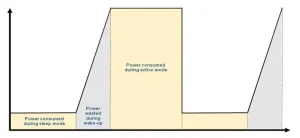
Source: Microcontroller Tips, Quantifying Embedded MCU Energy Consumption FAQ
Forcing the MCU to Sleep
Jure Jazbec didn’t reinvent the physics of silicon; he changed processor’s working schedule.
Replacing blocking delays with state machines or a non-blocking architecture allows the microcontroller to trigger a measurement, hand off control and immediately enter deep sleep mode.
In a low-power design, even a few milliamps consumed over a few milliseconds will drain your battery budget. But if you allow hundreds of microamps to remain active for hundreds of milliseconds, multiplied by thousands of daily cycles, this results in a massive energy loss.
By breaking down measurements into individual steps and putting the core into a dormant state during idle time, average current consumption is drastically reduced.
Stop blaming your hardware choices. Review your firmware libraries, eliminate blocking waits and force the processor to return to sleep mode within a microsecond once its work is done.
The Real Capabilities of RF Engineering
In real-world deployments, range and reliability are determined by the antenna, not the data sheet.
Off-the-shelf standard components often fail in complex and demanding radio environments. That’s why at Senzemo, our wireless LPWAN antennas are carefully designed, tested and tuned to meet the specific requirements of the enclosure, the used materials, mounting constraints and the installation environment.

Antenna performance directly dictates transmission time and overall battery lifecycle.
Junior engineers often fall into a common trap: “The device consumes 5 microamperes in sleep mode, so the battery will last for years.” But the reality is different. What matters to the battery is the total energy consumption over time under real-world operating conditions. If a LoRaWAN device repeatedly fails to establish a connection due to poor RF design or an insufficient antenna, the active transmission windows are extended and the energy reserve rapidly runs out. Cutting-edge antenna engineering goes far beyond simple signal transmission, it directly dictates the device’s entire lifecycle.
Experience Reflected in Our Products
Top-notch engineering expertise is demonstrated not in theoretical white papers, but in finished, scalable products.
A prime example is the SPU30, an advanced battery-powered IoT device featuring multiple environmental sensors, LoRaWAN communication, an NFC interface and extremely stringent power consumption requirements. When developing such a product, there is no room for individual subsystems to operate in isolation, as they are heavily dependent on one another.

Designing, testing and validating every circuit to perform under real-world conditions.
Structural and Mechanical Constraints
Circuit layout does not begin with random components, but rather with mechanical mountings, the positions of connectors, antennas and power supply requirements. Priority is given to those components (MCU, radio module, regulators) that determine the rest of the layout.
Layout precision
Every major component must have a precisely defined reason for its location; whether it is because of signal path length, current loop size, temperature, electromagnetic compatibility or physical requirements. For example, a condenser on a power supply pin is there strictly because it needs to be; that alone is half the work of successful routing.
Power Supply Robustness
Despite time constraints, there is no room for compromise when it comes to the power supply and the fundamental robustness of the circuit. You should avoid incorrect current connections, disregarding the manufacturer’s recommendations or solutions that work only under ideal conditions.
Risk Management
During circuit design, the greatest concern is simple yet critical errors that cannot be easily corrected later. These include an incorrect footprint, a swapped pin, incorrect polarity or a signal connected to the wrong MCU pin.
Overall energy profile and firmware
Optimization does not rely exclusively on the lowest measured sleep power consumption or the selection of a single “miracle” component. Consideration must be given to the total energy consumption over time under real-world operating conditions. By eliminating unnecessary blocking delays in the software and switching to non-blocking operation, the processor enters sleep mode during measurements, preventing the device from wasting precious microamperes over the course of a hundred milliseconds.
When all these components work in perfect harmony, the result is a product that stands out in the market for its unwavering reliability in the field.
What does this mean for our partners?
For companies looking to accelerate their development in the world of IoT and make a confident transition to the market, partnering with Senzemo offers concrete and measurable advantages.

Validated hardware execution handles physical constraints so you can focus strictly on software and data.
- Reduced technical risk: Before production begins, developmental bugs, incorrect footprints and poor power optimization are systematically eliminated. A precise debug process is implemented by breaking down the system into smaller blocks, checking power lines, power consumption and signal ground conditions, with changing only one variable at a time.
- Outstanding RF Performance: Custom-tuned antennas and carefully designed current loops ensure stable connections even in heavily obstructed or electrically noisy industrial environments.
- Proven battery longevity: A complete energy profile that factors in the quiet current flow of controllers, pull-up resistors, the amount of leakage power and actual operating time directly leads to lower field maintenance costs and greater end-customer trust.
- Faster time to market: With irreplaceable experts leading hardware development, innovative concepts are rapidly transformed into reliable, mass-produced devices.
Deploying reliable IoT at scale requires hardware engineering rooted entirely in physical realities and system discipline. If your IoT deployments demand absolute reliability in deep basements and noisy industrial environments, we are ready to build them with you.