

Most companies enter the world of IoT with high expectations. They install a few sensors, display the data on a dashboard and the early results look promising. Then comes the real test:
scaling up. What worked in a pilot project often breaks down when expanded to an entire production facility or even a city.
The numbers for 2026 still reflect the same challenge. While IoT continues to expand rapidly, many projects are still struggling to move beyond the prototype phase. Industry research shows that while most companies launch IoT initiatives, only a small percentage successfully scale them into fully operational systems that deliver long-term return on investment.
At Senzemo, we continue to observe the same pattern across all implementations: the challenge rarely lies in the technology itself. It is the strategy, integration and scalability behind it that matters.
Too often, IoT is treated as a standalone technical project rather than a strategic business initiative. As deployments expand, companies face unexpected challenges in connectivity, cybersecurity, data management, interoperability and maintenance costs. What seemed simple in the pilot phase becomes difficult to manage at a larger scale.
In 2026, successful IoT implementations are being increasingly driven by clear business goals, scalable architecture and the ability to turn real-time data into actionable insights through AI and automation. Companies that focus exclusively on devices and dashboards often struggle, while those who build long-term operational environments are seeing noticeable progress in efficiency, maintenance, energy optimization and business decisions.
To protect your investment and achieve real ROI, it is essential to understand where the hidden pitfalls lie before you invest in your first sensor.

Linking the pilot project to mass production is a matter of strategy, not just technology.
The Myths of Universal Connectivity (Why LoRaWAN Is Not Just Better Wi-Fi)
During the pilot phase, companies often underestimate how much physics and network architecture impact the total cost of ownership. Everything works in the lab, but once the system leaves controlled conditions, reality kicks in.
- Myth: Connectivity is just about moving data from point A to point B
Reality: Most pilots fail because they rely on technologies that are not resilient to real-world conditions. Wi-Fi and Bluetooth operate in the 2.4 GHz spectrum, which is one of the most crowded frequency bands. In industrial environments, metal structures and machinery cause signal reflections and packet loss.
Senzemo insight: LoRaWAN operates on sub-GHz frequencies (868 MHz), which naturally penetrate reinforced concrete and dense infrastructure. This is not just about range, it is about reliability in harsh environments.
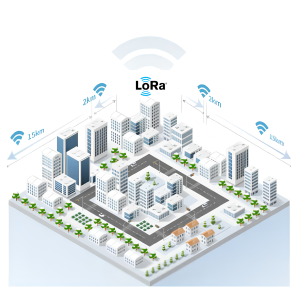
From deep penetration indoors to a range of up to 15 km outdoors LoRaWAN provides the reliable infrastructure needed for large-scale IoT deployments.
2. Myth: Battery life is not a concern
Reality: The biggest energy drain is the connection. With cellular technologies like NB-IoT, devices consume significant power during constant network synchronization, draining batteries faster than expected.
Senzemo insight: LoRaWAN uses an asynchronous communication model. Devices stay in sleep mode and only wake up to transmit data. The result is a difference between 1 year and 10 years of battery life.
The Data Overload Trap (Data Overload vs. Data Insight)
Most IoT pilots do not fail because of too little data, but because of too much useless data. Companies generate thousands of records that no one reviews, which is the fastest way to label the project as an unnecessary expense.
Senzemo insight: The goal is not data collection, it is noise reduction. Our systems alert users only when data moves outside defined operational thresholds, ensuring that only critical data points drive action.

From data overload to operational intelligence
Flawless SAP: Facts, Not Speculation
Senzemo sensors connect directly to SAP via API-first architecture, meaning data is visible in less than a second without middlemen. By converting raw data into Business Events, SAP receives one actionable signal instead of thousands of measurements. This enables Digital Twins and a shift toward predictive maintenance.
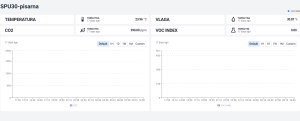
Seamless visibility across your entire infrastructure. From a single office to an entire smart city, our interface scales with your strategy, not just your device count.
Do not waste another year in pilot hell. Lay the groundwork that will make the transition to production. Get in touch with our team, and together we will ensure that your data becomes your greatest competitive advantage.