
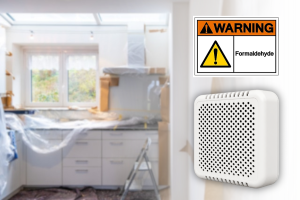
With new EU restrictions on formaldehyde emissions now in effect, businesses across Europe are paying closer attention to the materials used in their buildings. At Senzemo, we’re ready with an optional formaldehyde (HCHO) measurement for our Senspuck Pure SPU30 indoor air quality sensor, bringing greater insight into indoor environments.
New EU Rules Put Formaldehyde in Focus
The air inside a building is influenced by more than ventilation. Furniture, flooring, adhesives, wood-based panels, and construction materials can release chemical pollutants long after installation.
One of these pollutants is formaldehyde (HCHO), a substance associated with respiratory irritation and longer-term health risks.
Under EU Regulation 2023/1464, new formaldehyde emission limits took effect on 6 August 2026, introducing stricter requirements for furniture, wood-based articles, and other covered products placed on the European market.
The regulation sets emission limits of 0.062 mg/m³ for furniture and wood-based articles and 0.080 mg/m³ for other covered articles, measured under specified testing conditions.
Although these restrictions apply to product emissions rather than requiring continuous building monitoring, they reinforce the growing importance of understanding chemical pollutants in indoor spaces.
For building manufacturers, property operators, and facility managers, this brings a new opportunity to look beyond conventional indoor air quality indicators.

Senzemo Is Ready
Our Senspuck Pure SPU30 already monitors CO₂ and total volatile organic compounds (TVOC), providing valuable insights into ventilation and indoor air quality.
Now, we’re expanding its capabilities with optional formaldehyde (HCHO) measurement.
While CO₂ helps assess ventilation and TVOC provides a broader indication of chemical pollutants, a dedicated HCHO sensor allows users to monitor formaldehyde specifically.
By combining all three measurements, the SPU30 offers a more comprehensive understanding of indoor conditions in a single LoRaWAN-enabled monitoring solution.
For customers already considering CO₂ and TVOC monitoring, the optional HCHO addition provides an opportunity to address another important indoor pollutant without introducing a completely separate monitoring solution.
Built for Industries Where Indoor Air Quality Matters Most
Modular and prefabricated buildings
Speed, efficiency, and repeatability are essential in modular construction. With manufactured wall panels, flooring, furniture, and adhesives often installed within a short period, understanding potential material emissions becomes especially relevant.
Formaldehyde monitoring adds value for modular building manufacturers, rental providers, and operators who want greater visibility into indoor conditions across newly installed buildings, temporary offices, classrooms, and accommodation units.
Commercial real estate and facility management
Managing indoor air quality across an office building is one challenge. Managing it across hundreds of properties is another.
For commercial property owners and facility management companies, adding HCHO monitoring to existing CO₂ and TVOC measurements supports a broader view of indoor conditions, particularly following renovations, tenant fit-outs, or furniture replacements.
With LoRaWAN connectivity, the SPU30 can be integrated into centralized monitoring systems, making it suitable for deployments across multiple buildings and locations.
Hotels and hospitality
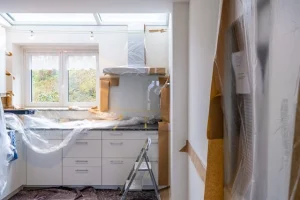
Guest comfort starts with the indoor environment. Hotels regularly renovate rooms, replace furniture, and update interior finishes, all of which can introduce new sources of chemical emissions.
Monitoring formaldehyde alongside CO₂ and TVOC gives hotel operators additional insight into room conditions, particularly in newly renovated or furnished areas.
For hotel groups managing large property portfolios, connected indoor air quality monitoring can support a more consistent approach across locations.

HVAC, building automation, and smart building solutions
For HVAC providers, system integrators, and smart building technology companies, indoor air quality monitoring is becoming an increasingly valuable part of building management.
Adding formaldehyde measurement creates opportunities to offer customers more targeted air quality data beyond CO₂ and TVOC.
The SPU30’s LoRaWAN connectivity and open-platform approach make it suitable for integration into broader building monitoring systems, enabling technology partners to develop scalable indoor air quality solutions.
Schools, healthcare, and public buildings
Indoor environments where people spend extended periods, particularly children and other vulnerable groups, deserve greater attention.
Schools, universities, healthcare facilities, and public buildings can benefit from additional insight into chemical pollutants originating from furniture, flooring, and building materials.
By extending existing air quality monitoring with HCHO measurements, facility operators can make more informed decisions about ventilation, renovations, and indoor environmental management.

One Sensor. More Measurements. More Possibilities.
At Senzemo, we develop sensor solutions designed for real-world applications, from individual buildings to large-scale IoT deployments.
The optional HCHO addition expands the SPU30’s capabilities while maintaining its core advantages: easy installation, LoRaWAN connectivity, flexible integration, and compatibility with different monitoring platforms.
Whether you’re managing a hotel portfolio, manufacturing modular buildings, operating commercial properties, or integrating smart building technologies, the expanded SPU30 offers a practical way to include formaldehyde in your indoor air quality monitoring strategy.
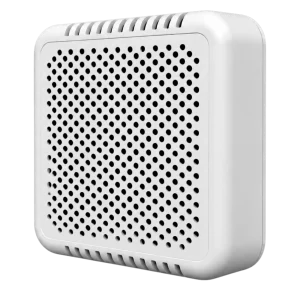
Existing Senspuck SPU30 CO2 and TVOC sensor can now optionally include also Formaldehyde Monitoring.
Explore Senspuck Pure SPU30 or contact Senzemo to discuss the right sensor configuration for your application.