
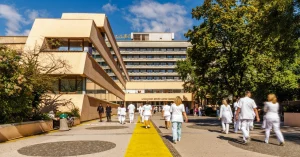
During a heatwave, the temperature people experience depends on much more than the weather forecast. Shade, buildings and pavement create local heat hotspots that can affect the comfort, safety and wellbeing of patients, visitors and staff. But how do we identify where people are actually exposed to dangerous heat?
Understanding the Heat We Cannot See
The same heatwave can feel very different across a city.
Traditional weather measurements usually tell us the general temperature of an area, but they do not show the differences that occur between individual locations. A few metres can make a significant difference depending on:
- the amount of shade available,
- surrounding building materials,
- the orientation of buildings,
- the presence of vegetation,
- the amount of heat stored by surfaces such as concrete and asphalt
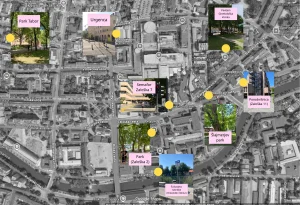
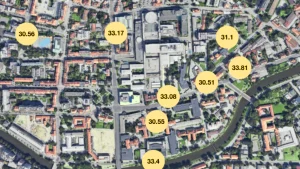
Ljubljana heat sensor map: tracking temperature variations from parks to urban surfaces.
These local variations create what we call microclimates, small-scale differences in environmental conditions that directly influence how people experience heat.
Without measuring these differences, it is difficult to know where the greatest risks actually occur.
Measuring Outdoor Heat Around Healthcare Facilities
During one of Slovenia’s extreme heat periods this summer, we installed Senstick SMC30-OUT sensors across selected outdoor areas of the University Medical Center Ljubljana (UKC Ljubljana) and the Institute of Oncology Ljubljana.
The monitoring was carried out as part of the CLISHE – Climate Shelters for Adaptation to Extreme Heat project.
Led by Prostorož, the project focuses on understanding thermal comfort around healthcare facilities and identifying opportunities to improve outdoor spaces for patients, visitors and healthcare staff.
The importance of understanding heat exposure around healthcare facilities was also highlighted in a RTV Slovenija video report.
Instead of measuring only general weather conditions, the sensors collect data from the places where people actually spend time.
Measurements were collected from the following locations:
- main hospital entrances,
- outdoor waiting and transition areas,
- green spaces used by patients,
- benches and pedestrian routes between buildings.
These are everyday spaces but during extreme heat, they can become areas of increased health risk.
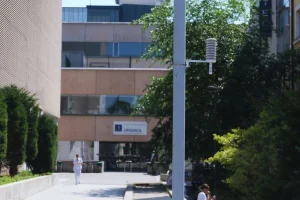
Monitoring thermal comfort at the emergency department entrance: a real-time assessment of heat exposure for patients and staff as part of the CLISHE project.
Small Distances Can Create Large Temperature Differences
One of the most important lessons from the monitoring is that heat exposure is highly localized.
Measurements showed that:
Large paved surfaces around hospital entrances absorbed and released significant amounts of heat.
Some areas that appeared shaded remained unexpectedly warm because nearby concrete walls continued radiating stored heat.
Outdoor spaces frequently used by patients during breaks could become significantly hotter during peak afternoon hours.
These conditions are difficult to identify by observation alone.
A space may look comfortable but still create uncomfortable or potentially harmful heat exposure.
This is why measurement matters.
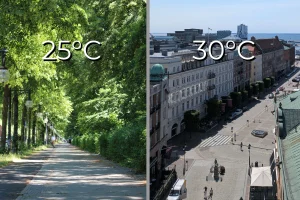
Contrast between a cool park and a urban heat island highlights why precise microclimate monitoring is essential for designing climate-resilient cities.
Why Heat Monitoring Matters for Healthcare
Heat is not only a question of comfort.
Extreme temperatures place additional stress on the human body, especially for people who are already vulnerable.
Elderly people, oncology patients and individuals with cardiovascular or respiratory conditions may be more sensitive to heat exposure. For these groups, even short periods in excessively warm environments can increase physical strain and worsen existing health challenges.
By identifying where heat accumulates, hospitals and planners can move from assumptions to evidence-based decisions.
Microclimate data can help support actions such as:
- identifying heat hotspots around healthcare facilities,
- directing people towards cooler outdoor areas,
- prioritising locations for new trees and vegetation,
- designing shade structures,
- improving future renovations with thermal comfort in mind.

Implementing smart shade structures around healthcare facilities provides a safe, cool environment for patients and staff, demonstrating how microclimate insights can directly improve healthcare accessibility.
From Data to Better Urban Design
At Senzemo, we believe environmental monitoring is most valuable when it leads to practical improvements.
The deployment of Senstick SMC30-OUT sensors within the CLISHE project demonstrates how environmental data can support architects, landscape designers, healthcare institutions and urban planners.
Instead of asking where people think it is hottest, measurements reveal where heat exposure actually occurs.
This creates a stronger foundation for designing healthier outdoor environments not only around hospitals, but also in:
- schools,
- nursing homes,
- public spaces,
- residential neighbourhoods
Technology alone does not solve urban heat challenges but accurate information helps guide the solutions.
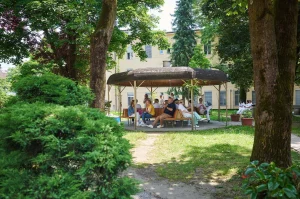
By utilizing precise environmental data, we can strategically place infrastructure like this shade pavilion, effectively reducing heat stress in critical areas.
Building More Heat-Resilient Cities
As climate change increases the frequency and intensity of heatwaves across Europe, thermal comfort is becoming an essential part of urban planning.
Creating safer cities requires collaboration between technology providers, designers, healthcare institutions and public authorities.
Projects such as CLISHE show how combining environmental monitoring with thoughtful design can help protect the people who are most vulnerable during extreme heat.
The first step is not planting trees or installing shade structures.
The first step is understanding the environment.

Turn environmental data into design clarity. Rent our sensors and bring precision to your urban planning projects.
Measure, Understand & Improve
Heat will remain one of the defining environmental challenges for cities in the coming decades.
Building healthier public spaces requires evidence-based planning and evidence begins with reliable measurement.
At Senzemo, we are proud to contribute to projects that use environmental sensing to improve quality of life and support healthier, more resilient communities.
Because when it comes to protecting people from extreme heat, the most effective strategy begins with three simple steps:
- Measuring
- Understanding
- Improving

By installing sensors like the Senstick SMC-30 OUT in everyday urban infrastructure, we move beyond assumptions