
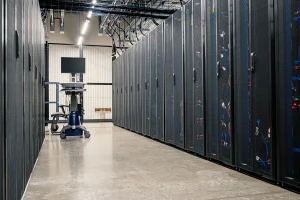
Modern data centers are under constant pressure to reduce energy consumption while maintaining absolute reliability. As compute density increases and AI workloads push infrastructure harder than ever, cooling systems have become one of the largest operational cost drivers.
Monitoring Cooling in Data Centers Brings Huge Savings
In many facilities, HVAC systems account for 30–50% of total energy usage. A significant portion of operational cost is therefore driven not by IT load, but by environmental control systems.
The limiting factor is not cooling capacity, but visibility into environmental conditions. Without granular data, operators cannot accurately determine where cooling is actually needed, which leads to conservative and inefficient system behavior.
New Senstick Ambient Sensor SAM20 addresses this limitation by providing continuous measurements of temperature, humidity and air pressure across the facility, enabling more informed cooling decisions and improved energy efficiency.
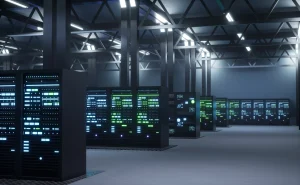
Modern data centers: Reducing cooling costs through granular environmental visibility
The hidden inefficiency problem
Cooling systems in data centers typically rely on limited sensor placement and averaged environmental readings. A small number of measurement points often define the behavior of entire zones.
This leads to three core inefficiencies:
Overcooling — Systems compensate for uncertainty by lowering setpoints beyond what is necessary, increasing energy consumption.
Thermal blind spots — Localized hotspots can form between racks or within airflow paths without being detected in time.
Reactive control — HVAC systems respond after deviations occur instead of preventing them through predictive adjustment.
The result is reduced efficiency, even in highly engineered environments, due to insufficient environmental resolution.
Reduce cooling-related energy waste by up to 15% through granular environmental visibility.
By measuring temperature, humidity and air pressure directly at rack level, SAM20 enables more precise cooling decisions, helping data center operators eliminate unnecessary overcooling while maintaining thermal stability.
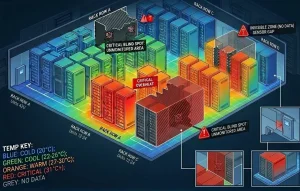
Addressing cooling inefficiencies: Moving beyond limited, averaged sensor readings.
Cooling inefficiency is spatial, not system-wide
A practical deployment does not start at room level, but at rack level where airflow behavior actually changes.
Instead of relying on aggregated environmental readings, ambient sensors should be placed at two critical points:
- at the cold air intake of a rack
- at the hot air exhaust
This creates a direct measurement of airflow performance across a single thermal cycle.
What this reveals is often not visible at room level:
- how efficiently cooling air is actually used
- whether heat is removed consistently across servers
- whether airflow is partially blocked or recirculating
- where micro-hotspots begin to form inside racks
Most cooling inefficiencies are not caused by system failure but by uneven airflow distribution that remains invisible without point-to-point measurement.
As sensor coverage expands across aisles, these local measurements scale into a full environmental model of the facility.
Most HVAC systems fail not at the room level, but at the micro-level, inside airflow channels between racks.
This is why traditional monitoring often shows “normal conditions” while localized overheating still occurs.
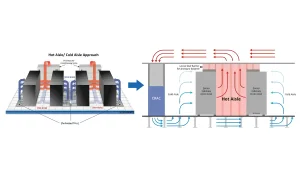
Spatial cooling: Transitioning from room-level averages to rack-level precision.
Environmental Visibility Starts with Sensor Placement
Cooling performance is defined by how well environmental conditions are measured across space, not by isolated data points.
Airflow behavior depends on multiple interacting variables:
- Temperature distribution
- Relative humidity
- Air pressure differences influencing airflow direction
Small variations in these parameters can significantly alter airflow patterns, directly affecting cooling efficiency and hotspot formation.
Without distributed measurement across the environment, optimization remains fundamentally incomplete.
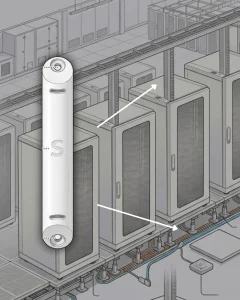
Optimized Thermal Control: Eliminating guesswork by placing sensors directly at the rack’s critical airflow points.
Solution = SAM20 Ambient Sensor
SAM20 is not a monitoring add-on but a shift in measurement granularity, enabling visibility into airflow behavior at rack level that room-level systems cannot resolve.
It captures temperature, humidity, and air pressure directly within airflow paths, at the point where cooling air is actually consumed and heat is expelled.
By measuring conditions at this transition layer, airflow is no longer inferred from averaged room data but observed as a physical, measurable process. This creates the foundation for understanding cooling performance where it actually breaks down, inside rack-level airflow dynamics.

SAM20: Precision rack-level sensing for granular airflow visibility.
SAM20 as an Environmental Data Layer
SAM20 is designed as part of a broader infrastructure monitoring system rather than a standalone solution.
Its value is defined by three characteristics:
Easy deployment — Sensor density only scales if installation is simple and non-disruptive.
Cost efficiency — Large-scale optimization requires economically viable monitoring at scale.
Environmental completeness — Temperature, humidity and air pressure together form the minimal dataset required to understand airflow behavior beyond surface-level readings.
In this context, SAM20 acts as a data layer that enables downstream optimization systems to operate on real environmental conditions.
Who Benefits from This Approach
This approach is relevant for organizations operating environments where small thermal deviations can lead to significant cost or reliability impacts.
It applies to data center operators in colocation and enterprise facilities, cloud providers managing distributed infrastructure, industrial IT environments with high compute density and facility teams focused on energy efficiency and PUE reduction.
The key factor is not organization size, but the requirement to balance energy consumption with thermal stability and uptime.

Optimize data center cooling with real-time sensor data.
Distributed ambient monitoring reduces several inefficiencies common in traditional cooling setups.
It reduces unnecessary cooling driven by conservative safety margins based on incomplete data. It improves detection of localized overheating that may otherwise remain invisible. It also increases visibility into airflow behavior, which is often assumed rather than measured.
In addition, it improves alignment between HVAC system behavior and real environmental conditions, reducing reliance on reactive adjustments.
Over time, this enables earlier detection of anomalies and more stable operational performance.
Traditional Monitoring vs Distributed Visibility
Traditional monitoring systems are designed primarily for stability, not optimization. They rely on limited sensor placement and centralized control logic.
A distributed monitoring approach shifts the objective from maintaining safe averages to understanding spatial environmental behavior in real time.
However, sensors alone do not create optimization. Value emerges only when environmental data is integrated into systems capable of acting on it, such as analytics platforms or HVAC control logic.
Without this integration, even high-resolution data remains underutilized.
Data center inefficiencies are rarely caused by insufficient cooling capacity. They are primarily the result of limited environmental visibility at the required spatial resolution.
HVAC systems operate conservatively because they cannot fully observe conditions within the environments they regulate.
Distributed ambient monitoring addresses this limitation by turning environmental conditions into structured, actionable data.
Devices such as SAM20 represent the foundational sensing layer of this approach, enabling better decisions, improved airflow understanding and measurable reductions in energy consumption.

Data center management: Enhancing efficiency through real-time environmental monitoring.