
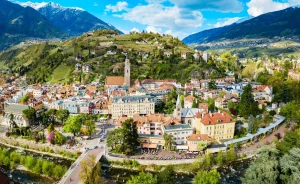
Climate change is no longer a distant projection on television, but a daily reality cities face worldwide. When summer temperatures consistently push past 35 or even 40 degrees Celsius, heatwaves strike hardest where we least expect them, in the alpine environment.
Nestled in the heart of South Tyrol, two neighboring alpine cities, Merano and Bolzano, are confronting these challenges head-on. Despite being surrounded by mountains and greenery, they face severe urban heat islands, worsening air pollution and extreme weather fluctuations. The answer to this crisis lies not just in traditional construction, but in a powerful blend of advanced technology, smart data and nature-based solutions.
An Alpine Basin Under Heat Pressure
Cities naturally attract heat. Concrete, asphalt and dense buildings absorb solar radiation during the day, releasing it slowly at night and preventing natural cooling.
In the alpine basin, this phenomenon is even more pronounced:
Intense Sunlight: Due to exceptionally clean mountain air, solar rays are much stronger and more piercing.
The Heat-Trap of Historic Architecture: Historic city centers feature older buildings that store heat and radiate it back out at night. Experts have recorded microclimatic temperature differences of up to 8 degrees Celsius on the exact same street, depending on building materials and density.
While Merano struggles with urban densification threatening its historic tree canopy, Bolzano’s industrial district suffocates under concrete and traffic.
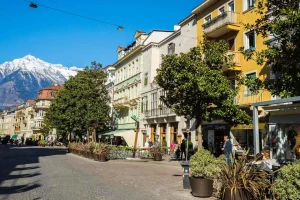
Historic streets of Merano framed by snowy alpine peaks, showcasing the architectural blend that traps intense solar radiation and creates pronounced urban heat islands.
How Smart Sensors Reveal the Invisible Hotspots
To take effective action, we must first measure the problem.
In Merano, local authorities partnered with the municipal utility Stadtwerke Meran and technical experts to introduce digital temperature monitoring.
Advanced Sensor Network: Over 30 microclimate sensors (Senstick Microclimate SMC30-OUT) were deployed across the city to precisely compare temperatures between hot asphalt zones and shaded parks.
LoRaWAN Infrastructure: The municipal utility established its own low-power wireless network, enabling seamless, long-range data transmission.
Open-Source Platform: The city doesn’t hide its data away. All sensor measurements are publicly accessible via an open-source web dashboard, fostering transparency and public trust.
Reliable data allows the city administration to pinpoint precisely which streets urgently need more trees, shade or water features while optimizing municipal resource management.
The open-source dashboard of Stadtwerke Meran visualizes real-time microclimate sensor data across the city.
From Precise Data to Green Action
Data is only the starting point. Through the European project JUSTNature, both cities began implementing concrete initiatives focused on harmony with nature and community engagement.
1. Merano: Protecting Trees and the Garden for All
Cutting-Edge Tree Mapping: Using LiDAR laser scanning, Merano mapped thousands of trees across the city, evaluating their health and cooling impact on the local microclimate.
New Urban Planning Rules: for every two parking spaces removed, a new tree must be planted and new developments must incorporate green roofs or support biodiversity.
The Garden for All: Through interactive workshops using visual tools and LEGO bricks (which helped bridge the communication gap between German and Italian-speaking residents), locals co-created a public edible garden.
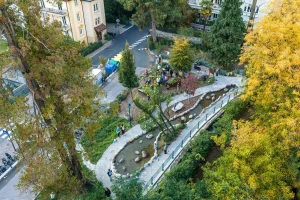
Garden for All
2. Bolzano: Greening the Industrial District
Rooftop Corridors: Bolzano’s industrial zone features massive expanses of flat roofs (nearly 68 hectares of potential surface area). As a pilot project, a solar green roof was installed on a municipal building, creating the first ecological corridors between rooftops.
Street-Level Transformations: Concrete was removed around an international bus stop and replaced with vegetation, shrubs and stormwater retention systems, noticeably cooling the local microclimate.
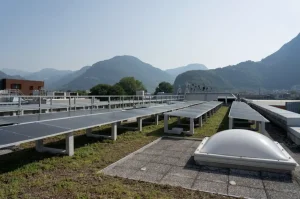
Integrating solar panels with vegetation, this pilot project in Bolzano transforms industrial rooftops into connected ecological corridors.
What Other Cities Can Learn From the Alps
The experiences of these two alpine cities offer key lessons for the future of urban planning:
1. Technology and Community Go Hand in Hand
Sensors reveal where heat islands are worst, but residents know best how and where they want to spend their time.
2. Listen to the Locals
Urban planners must sometimes look beyond strict technical logic to honor community wishes such as preserving an old tree that children have formed an emotional attachment to.
3. Pilots Must Become Policy
The true value of projects like JUSTNature lies not in a single renovated square, but in how they permanently alter municipal regulations and urban living culture.
Merano and Bolzano prove that the future of alpine cities does not lie in more concrete but in a smart, green and inclusive environment that breathes alongside nature.
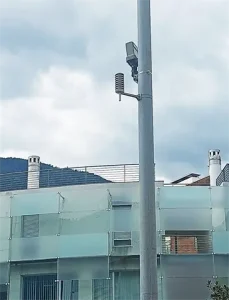
Sensors like this were strategically placed in selected areas to monitor temperature variations between asphalt-heavy zones and green spaces.