
In the world of IoT and environmental monitoring, speed and flexibility are critical. Developing reliable sensors is not only about electronics, firmware and cloud platforms, it is equally about the physical hardware that protects those systems in real-world conditions.
At Senzemo, we develop advanced environmental monitoring solutions designed to operate in demanding outdoor environments. Our sensors are deployed where accuracy, reliability and durability matter. However, great hardware does not appear instantly. Behind every successful product is a long process of testing, adjusting and improving. A small change in an enclosure design, mounting mechanism, airflow structure or protective component can significantly impact the final performance of a device.
That changed when we introduced the Bambu Lab H2D 3D printer into our workspace.
The Challenge of Hardware Iteration
Every hardware development team knows that the first version is rarely the final version.
A concept might look perfect in CAD, but the real world always reveals new challenges:
- Does the enclosure fit correctly?
- Are the mounting points strong enough?
- Is the airflow optimized?
- Can the design survive outdoor conditions?
Previously, creating and testing physical prototypes often involved external manufacturing services or slower internal processes. Even a relatively small design modification could introduce delays.
A typical iteration cycle could look like this:
- Update the CAD design.
- Send the prototype for production or wait for available printing capacity.
- Wait for the part to arrive.
- Test it.
- Discover improvements are needed.
- Repeat the entire process.
For product development, these delays add up quickly. Innovation depends on the ability to test ideas, fail quickly, learn and improve. The longer the feedback loop, the slower the entire development process becomes.
We needed a solution that would allow our engineers to move directly from digital design to physical testing without unnecessary barriers.
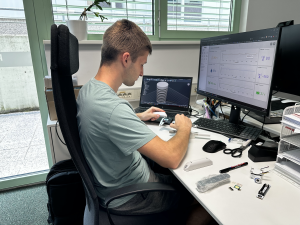
Before a prototype becomes a real product, every idea starts with engineering design. Reducing the gap between digital models and physical testing is essential for faster hardware development.
Bringing Professional Prototyping Capabilities In-House
The arrival of the Bambu Lab H2D changed the way we approach hardware development.
Instead of treating 3D printing as a separate production step, we integrated it directly into our engineering workflow. A new idea can now move from concept to prototype within hours rather than days.
This independence gives our team something extremely valuable: freedom to experiment.
When engineers can physically test their ideas immediately, they are encouraged to explore more solutions. Small improvements that previously might have been postponed because they required too much effort can now be tested quickly.
The H2D has effectively transformed our office into a small prototyping lab, where mechanical design and real-world testing happen much closer together.
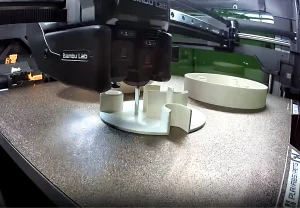
From digital design to physical prototype in hours. The Bambu Lab H2D allows our engineering team to rapidly test and refine hardware concepts directly in-house.
Why it Fits Our Needs
The Bambu Lab H2D is not just a fast desktop 3D printer. It is designed as a reliable prototyping platform capable of producing functional parts rather than only visual models.
Several features make it especially valuable for our workflow.
Dual-Nozzle Printing and Design Freedom
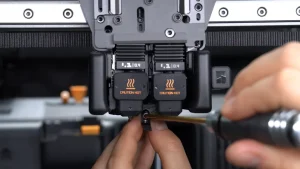
One of the biggest advantages is the dual-nozzle system.
Complex mechanical parts often require support structures, especially when designing components with challenging geometries. Being able to use different materials for the main structure and supports gives us more flexibility when designing parts.
This means fewer compromises during the design phase and easier production of more complex shapes.
Precision and Repeatability
For prototypes, accuracy is essential.
A prototype is only useful if it represents the final product as closely as possible. The H2D allows us to create detailed mechanical parts with consistent results, helping us validate designs before moving toward larger-scale manufacturing.
This is especially important for sensor housings, where small dimensional differences can affect assembly, sealing, airflow and mounting.
Engineering-Grade Materials
Outdoor IoT devices face challenging conditions. UV exposure, temperature changes, moisture and mechanical stress all influence the lifetime of a product.
The ability to work with stronger technical materials allows us to create prototypes that are much closer to real-world production parts. Instead of only creating a visual representation, we can test components that behave similarly to the final product.
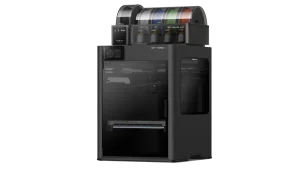
The new Bambu Lab H2D.
Real Example: Developing the Next-Generation of Outdoor Senstick Microclimate
One of the best examples of how the Bambu Lab H2D has transformed our development process is the ongoing prototyping of the next-generation Senstick SMC30-OUT sensor.
Currently under development, the new SMC30-OUT represents the next evolution of our outdoor sensing platform. As with any new hardware product, reaching the optimal design requires multiple iterations, testing and continuous refinement. One of the key components we are currently prototyping is the sensor’s protective radiation shield.
The radiation shield plays a critical role in the overall performance of the sensor. It must protect the electronics from rain, dust and UV exposure while allowing sufficient airflow around the sensing elements to ensure accurate environmental measurements.
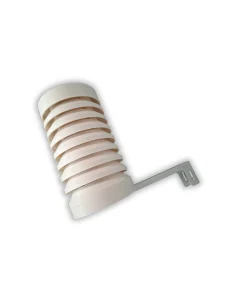
Prototype in Progress – Next-Generation Senstick SMC30-OUT
Designing such a component requires balancing several important factors:
- Protection from rain, dust, and UV exposure
- Sufficient airflow for precise measurements
- Mechanical strength and long-term durability
- Ease of assembly and maintenance
- Manufacturability for future production
Before bringing prototyping in-house, even small design changes could slow development considerably. Today, using the Bambu Lab H2D, we can modify the CAD model, print a new prototype, assemble it and evaluate the results within the same day.
This significantly shortens our design cycle and allows us to compare multiple design variations before selecting the best solution.
More Than Just Faster Printing
The biggest impact of the Bambu Lab H2D is not simply print speed.
The real value is independence.
By bringing prototyping capabilities in-house, Senzemo has gained more control over the entire hardware development process.
- Faster Innovation
Ideas can move from imagination to reality much faster. Engineers can test more concepts, compare different solutions, and improve designs through rapid iteration.
- Reduced Development Bottlenecks
External production steps are no longer slowing down early-stage development. Instead of waiting for prototypes, we can create them whenever needed.
- Better Product Quality
More testing cycles lead to better products. Before a component reaches customers, we can evaluate its mechanical performance, usability and integration with the complete system.
- Greater Creative Freedom
Perhaps the most important change is psychological. When creating prototypes becomes easy, teams naturally experiment more. They are less limited by the cost and effort of trying new ideas.
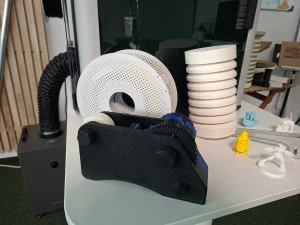
Building the Future of Senzemo Hardware
At Senzemo, our mission is to create reliable environmental monitoring solutions that provide meaningful data from the real world. Achieving that goal requires not only intelligent software and accurate sensors but also carefully engineered physical products.

Having advanced prototyping capabilities directly in our workspace allows us to move faster, test more and build better.
The H2D has become an important part of our daily engineering workflow, helping us transform ideas into functional hardware and bringing us closer to a future where innovation is limited only by imagination.