When you work in food safety, “close enough” temperature data is not enough. A customer does not care how good a lab graph looks. They care what happens when doors open, airflow changes, staff move products, and the real world creates noise in the measurements.
That is exactly why our long term food safety partner came to us with a clear request. They were already using our STO10 temperature sensor, but for HACCP deployments they needed an additional temperature channel that behaves like a product simulant. Something with a slower, more product like thermal response, not just an ambient air reading. And they needed it fast.
They had a hard deadline tied to rollout timelines at major hotel chains such as Hyatt and Sheraton. In practice this meant one thing: if the device was late, the entire project would slip.
We delivered the STB10 in three weeks

The challenge
On paper, the request sounds simple: add a buffer temperature. In reality, it changes the whole chain. You need two measurements that are meaningful in the field, not just in controlled conditions. You need a compact design that does not compromise battery life, radio behavior, or reliability. You need an enclosure and assembly process that can survive real installations. And you still need to follow proper validation and QA, even under time pressure, because this was not a lab demo. It was going straight into serious customer environments.

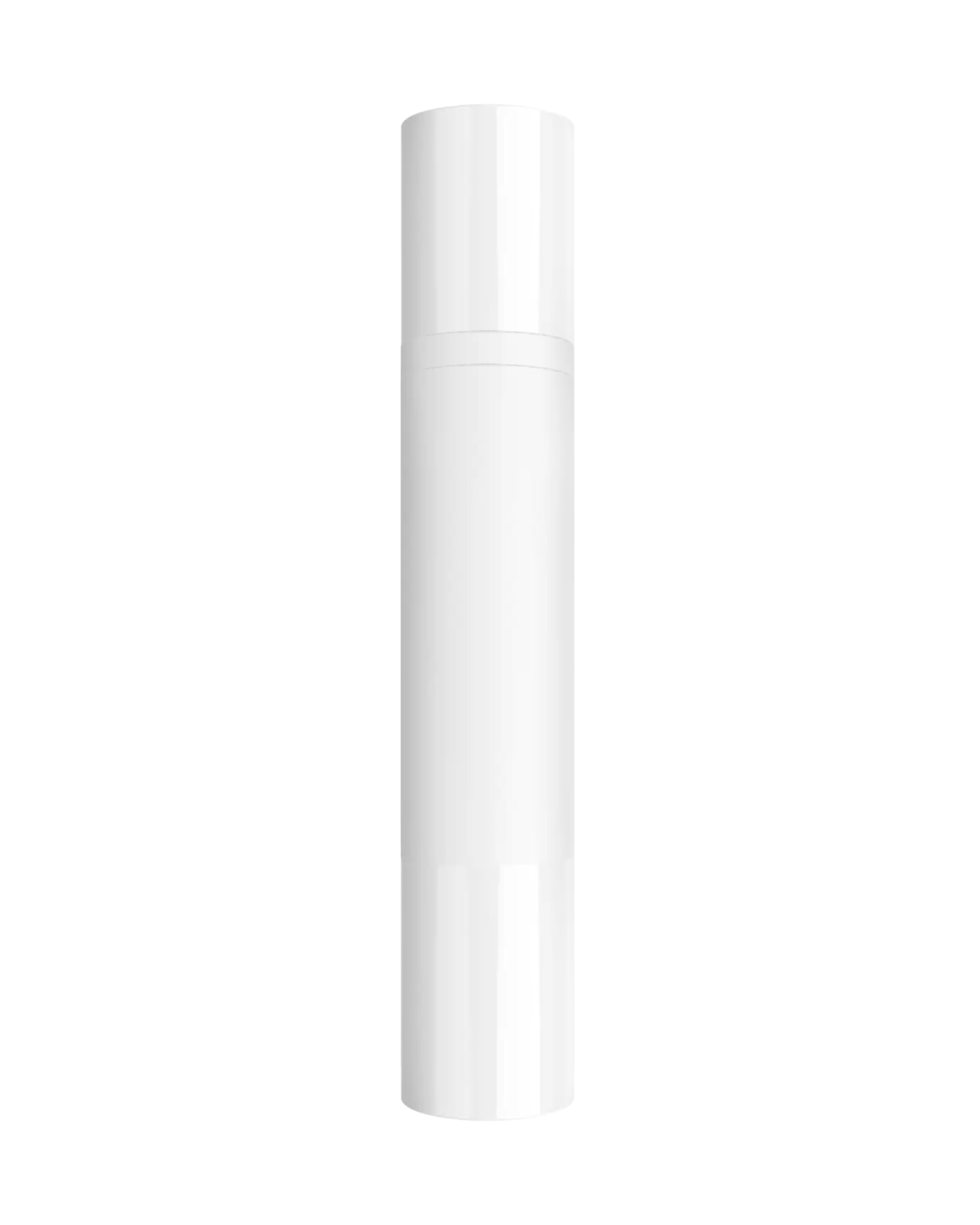
STB10 Temperature Buffer Sensor
Starting from STO10
The reason three weeks was possible is that we did not start from scratch. STB10 was born from a proven platform: STO10. That gave us a stable base in electronics, firmware, and manufacturing. It also meant our LoRaWAN behavior, provisioning workflow, enclosure concept, and test procedures were already mature. When timelines are tight, reducing unknowns is everything.

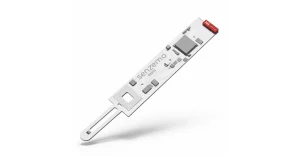
STO10 Temperature Only Sensor
What we changed to create STB10
The core of STB10 is the thermal buffer. The goal is not to “average” temperature, but to emulate the response of a product. Ambient air reacts quickly. A product reacts slowly. If you measure only air, you often end up reacting to short spikes caused by door openings or airflow changes. If you measure only a slow response, you may miss early signals. The partner needed both.
STB10 therefore measures two temperatures in parallel: ambient temperature and buffered temperature. The buffered channel uses a thermal buffer filled with glass beads, which provides a slower, more product like response. This dual sensing approach helps distinguish between short transients and sustained drift. In practical food safety deployments, that can be the difference between false alarms and actionable alerts.
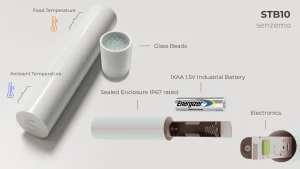
The inside of a STB10
Mechanical reality and installation details
A buffer concept only works if the physical setup is repeatable. That is where many fast hardware projects fail. We paid attention to the buffer geometry, enclosure fit, and assembly consistency so the buffer behaves the same unit to unit. We also defined a clear installation orientation, because the glass bead thermal buffer needs to be distributed evenly around the sensing element for consistent behavior in the field.
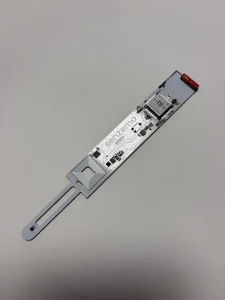
The electronic
Firmware and data behavior
We kept the device simple to deploy. The goal was not to introduce a “special” product that creates integration work. STB10 follows the same deployment logic as our existing devices, with predictable reporting and a clear payload structure that includes both ambient and buffered temperature. This allowed our partner to integrate quickly and focus on rollout, not on custom development.

STB10 Temperature Buffer Sensor
Validation and testing, even under pressure
The important part is what happened after we had a working prototype. We did not ship a rushed one off. We ran STB10 through our standard pre shipment process, including network behavior checks, stable reporting verification, payload decoding validation, and measurement sanity checks. For projects like this, consistent device level QC is part of the product, because the cost of a field problem is always higher than the cost of catching it before shipment.
The result
In three weeks we delivered a compact sensor that combines ambient temperature and a product like buffered temperature response in one device. Our partner was able to deploy it immediately and stay on schedule for their rollout.
The bigger takeaway is simple. Scaling does not happen because you talk better. It happens when execution is predictable. In this case, a clear requirement, a mature base product, and disciplined engineering plus operations made the timeline possible.
If you are working on HACCP digitalization or cold chain monitoring and you need temperature data that reflects the product, not just the air, STB10 was built for exactly that reality.